
Choose your reading length
Last November, Sovereign Cloud Came to Dresden
A Linux practitioner visits the ALASCA Summit 2025 — and finds Europe’s sovereign infrastructure further along than expected.
Last November, around 200 people gathered at the Deutsche Hygiene Museum in Dresden for the second ALASCA Summit. ALASCA — the Association for Operational, Open Cloud Infrastructures — is a community building open-source cloud infrastructure for Europe. The motto this year: “Not from Alaska. From Europe. Built for Europe’s Cloud Future.” I live in Dresden. I went because I wanted to feel how this community ticks — whether digital sovereignty is still a policy aspiration or something people are actually building.
The answer was clear within the first hour: they are building. And the timing made it impossible to ignore.
Days before the summit, the International Criminal Court in The Hague confirmed it would replace Microsoft Office with openDesk, the open-source workplace suite developed by ZenDiS, Germany’s Centre for Digital Sovereignty. The reason was blunt: after US sanctions on ICC officials and reports that the chief prosecutor had been locked out of his Microsoft account, the court decided it could no longer afford the dependency. The presenter from ZenDiS showed that openDesk is already running for the Ministerpräsidentenkonferenz, the Bundestag administration, and over 65,000 teachers in Baden-Württemberg. The Bundeswehr is piloting it on-premise.
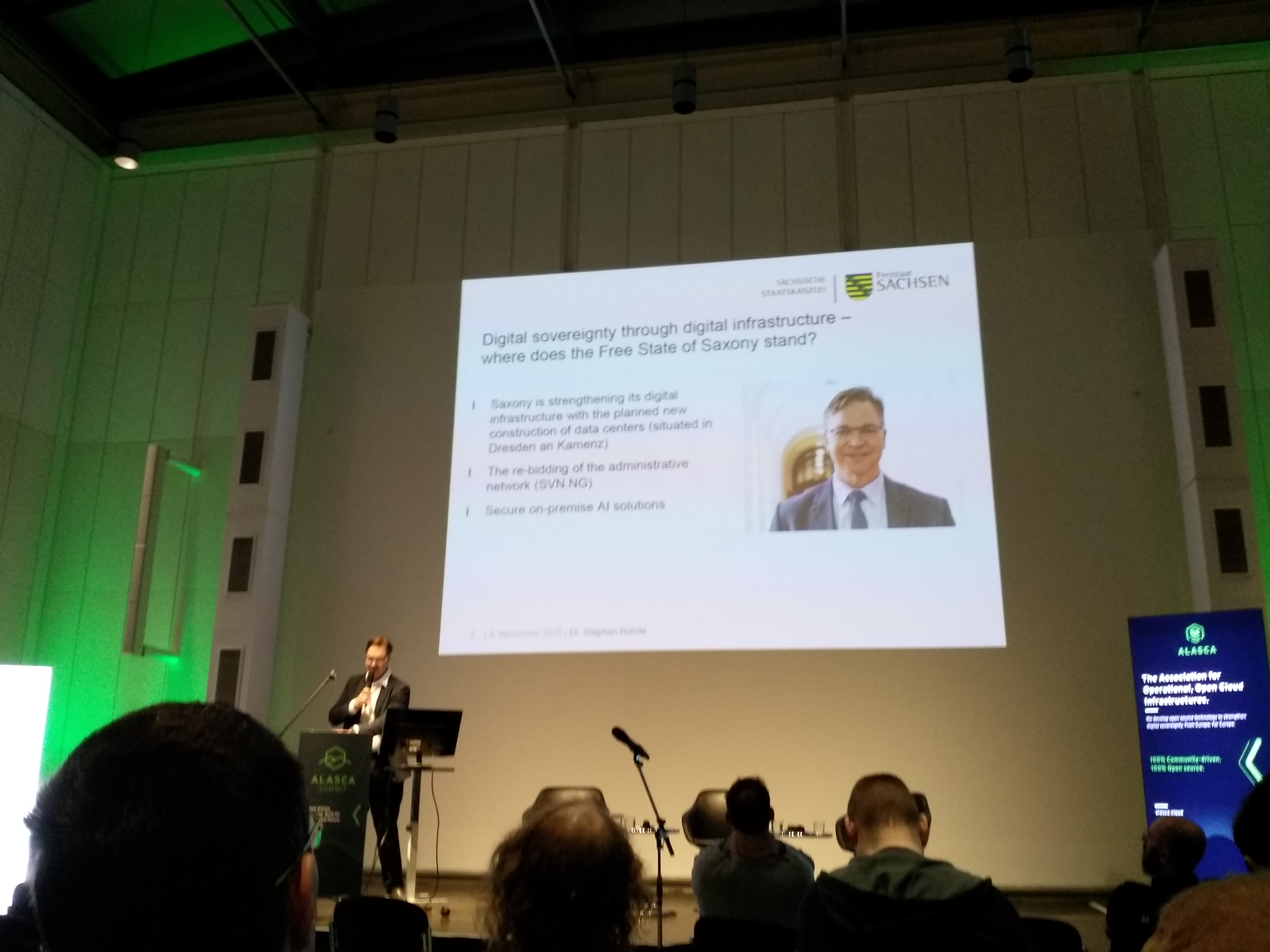
A presenter from the Saxon State Chancellery put the geopolitical context plainly: the current US administration made us realise how vulnerable we are. Saxony is building new data centres in Dresden and Kamenz, consolidating infrastructure, and standardising on the German Administration Cloud.
What struck me most, as someone who is a Linux native, is that German government is finally taking Linux seriously. One presenter called it “the European operating system.” That is not quite true — Linux is global, not European, and the Linux Foundation is based in San Francisco. But the sentiment points at something real: Linux is the one layer of the stack where no single company or government holds the keys. And at this summit, it was Linux all the way down. The network switches run SONiC — an open-source network operating system built on Debian. The cloud platform runs on OSISM and OpenStack. Kubernetes orchestrates the containers. The workplace applications are all open source. From switch to spreadsheet, the entire sovereign stack runs on foundations that no one can sanction away.
I came to observe. I left understanding that the gap between where I stand and where this community is building is narrower than I had assumed — and worth crossing.
Further reading
The ICC moment — in detail
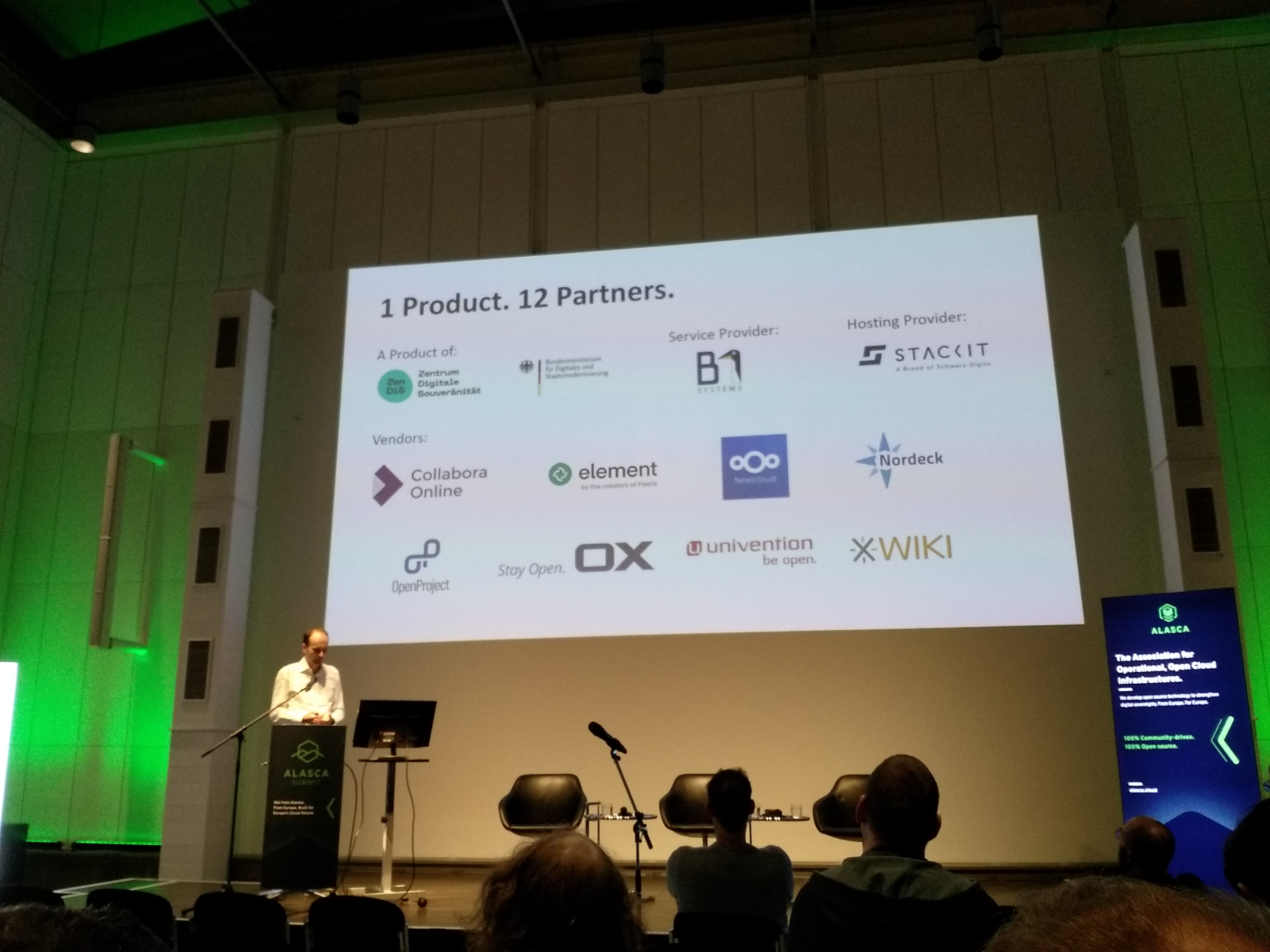
The presenter from ZenDiS showed what openDesk looks like in practice. The architecture slide read “1 Product. 12 Partners.” — ZenDiS and the Bundesministerium für Digitales as product owners, B1 Systems as service provider, STACKIT as hosting provider, and eight open-source vendors supplying the components: Collabora Online for documents, Element for messaging, Nextcloud for file storage, Open-Xchange for email and calendar, OpenProject for project management, XWiki for knowledge management, Univention for identity management, and Nordeck for collaborative widgets. The whole suite runs on Kubernetes, deployed via HELM charts.
The scale of real deployments is striking. openDesk is running for the Ministerpräsidentenkonferenz, the Bundestag administration, and over 65,000 teachers in Baden-Württemberg — with a target of 120,000. The Bundeswehr is piloting it on-premise through BWI GmbH, with rollout planned from 2027. The development roadmap includes AI integration through projects KIPITZ and F13, and a central installation for the federal government at the VS-NfD security classification level.
Saxony’s infrastructure response
Saxony is not just talking about sovereignty. Two new data centres are being built in Dresden and Kamenz. The state is standardising on the German Administration Cloud (DVC), building a platform for on-premise AI applications, and procuring the Saxon Next Generation Administrative Network (SVN NG).
SONiC — where networking meets Linux
SONiC is an open-source network operating system built on Debian, originally developed by Microsoft for Azure’s data centres, now governed by the Linux Foundation. It runs on switches from multiple hardware vendors, uses containerised microservices, and manages configuration through a Redis database. This touched something older in me than my Linux work. There were years in my career where I went deep into networking — reading RFCs, building VPNs, running sophisticated monitoring infrastructure with tools like HP OpenView and NetFlow probes. That world and the Linux world were always adjacent but never quite the same thing. SONiC merges them.
Reflection
Four months later, the momentum has only accelerated. The European Summit on Digital Sovereignty took place in Berlin in November 2025. The Sovereign Cloud Stack project released R8 despite losing its federal funding. SCS is now being deployed as government cloud infrastructure in countries from Guinea to Jordan.
I came as an observer — someone whose career has moved through networking, Linux systems, and now toward cloud infrastructure. I left understanding that the gap is narrower than I had assumed. The stack speaks languages I have spoken for years.
Last November, Sovereign Cloud Came to Dresden
A Linux practitioner visits the ALASCA Summit 2025 — and finds Europe’s sovereign infrastructure further along than expected.
Last November, around 200 people gathered at the Deutsche Hygiene Museum in Dresden for the second ALASCA Summit. ALASCA — the Association for Operational, Open Cloud Infrastructures — is a community building open-source cloud infrastructure for Europe. The motto this year: “Not from Alaska. From Europe. Built for Europe’s Cloud Future.” I live in Dresden. I went because I wanted to feel how this community ticks — whether digital sovereignty is still a policy aspiration or something people are actually building.
The answer was clear within the first hour: they are building. And the timing made it impossible to ignore.
The ICC moment
Days before the summit, the International Criminal Court in The Hague confirmed it would replace Microsoft Office with openDesk, the open-source workplace suite developed by ZenDiS, Germany’s Centre for Digital Sovereignty. The trigger was geopolitical: after US sanctions on ICC officials and reports that the chief prosecutor had been locked out of his Microsoft account, the court decided it could no longer afford the dependency.
The presenter from ZenDiS showed what openDesk looks like in practice. The architecture slide read “1 Product. 12 Partners.” — ZenDiS and the Bundesministerium für Digitales as product owners, B1 Systems as service provider, STACKIT as hosting provider, and eight open-source vendors supplying the components: Collabora Online for documents, Element for messaging, Nextcloud for file storage, Open-Xchange for email and calendar, OpenProject for project management, XWiki for knowledge management, Univention for identity management, and Nordeck for collaborative widgets. The whole suite runs on Kubernetes, deployed via HELM charts.
This is not a prototype. openDesk is already running as SaaS for the Ministerpräsidentenkonferenz, the Bundestag administration, and over 65,000 teachers in Baden-Württemberg — with a target of 120,000. The Bundeswehr is piloting it on-premise through BWI GmbH, with rollout planned from 2027. The development roadmap includes AI integration through projects called KIPITZ and F13, connections to specialised administrative systems (Fachverfahrensanbindung), and a central openDesk installation for the federal government at ITZ-Bund at the VS-NfD security classification level.
Saxony’s move
A presenter from the Saxon State Chancellery put the geopolitical context plainly: the current US administration made us realise how vulnerable we are. Dresden competes with cities like Singapore — and those partners cannot have their data on US servers.
Saxony is responding with infrastructure. Two new data centres are being built in Dresden and Kamenz, consolidating what is currently a decentralised landscape. The state is standardising on the German Administration Cloud (DVC), building a platform for on-premise AI applications, and procuring the Saxon Next Generation Administrative Network (SVN NG). This is not abstract strategy. It is procurement, construction, and deployment.
Linux all the way down
What struck me most, as someone who is a Linux native, is that German government is finally taking Linux seriously. One presenter called it “the European operating system.” That is not quite true — Linux is global, not European, and the Linux Foundation is based in San Francisco. But the sentiment points at something real: Linux is the one layer of the stack where no single company or government holds the keys.
One presentation that caught my attention more than any other was SONiC — Software for Open Networking in the Cloud. It is an open-source network operating system built on Debian, originally developed by Microsoft for Azure’s data centres, now governed by the Linux Foundation. It runs on switches from multiple hardware vendors, uses containerised microservices, and manages configuration through a Redis database. This touched something older in me than my Linux work. There were years in my career where I went deep into networking — reading RFCs, building VPNs, running sophisticated monitoring infrastructure with tools like HP OpenView and NetFlow probes. That world and the Linux world were always adjacent but never quite the same thing. SONiC merges them. The fact that the network switching layer now speaks Debian means that someone with roots in both worlds can work the entire stack in a language they already know.
And at this summit, it was Linux all the way down. The network fabric runs SONiC. The cloud platform runs on OSISM and OpenStack. Kubernetes orchestrates the containers. The workplace applications are all open source. From switch to spreadsheet, the entire sovereign stack runs on foundations that no one can sanction away.
Reflection
Four months later, the momentum has only accelerated. The European Summit on Digital Sovereignty took place in Berlin in November 2025, co-led by Germany and France. The Sovereign Cloud Stack project released R8 in April 2025 despite losing its federal funding — carried forward by committed companies and an active open-source community. SCS is now being deployed as government cloud infrastructure in countries from Guinea to Jordan.
I came to the ALASCA Summit as an observer — someone whose career has moved through networking, Linux systems, and now toward cloud infrastructure. I left understanding that the gap between where I stand and where this community is building is narrower than I had assumed. The stack speaks languages I have spoken for years. The community is serious. And Dresden, as it turns out, is not a bad place to be standing when this wave arrives.
Further reading
The stack beneath the stack
ALASCA’s technical projects have doubled from three to six since the first summit in 2024. The second day featured hands-on workshops on SCS standards, SONiC, and ALASCA’s own projects Krake, Yaook, and Tarook. A World Café session addressed “sovereignty washing” — the growing problem of organisations claiming sovereign credentials without delivering on them.
The cloud infrastructure layer is represented by OSISM — a platform for managing software-defined cloud infrastructure built on OpenStack, and the core of the Sovereign Cloud Stack (SCS) reference implementation. SCS lost its federal funding at the end of 2024, but committed companies formed the Forum SCS-Standards within the OSBA and continued developing. More than half a dozen public cloud operators use SCS in production.
The Kubernetes layer offers Gardener (now under the NeoNephos Foundation, a Linux Foundation initiative) and Cluster API. At the networking layer, the SECA API — the Sovereign Europe Cloud API co-created by Aruba, IONOS, and Dynamo — pushes toward European interoperability standards.
What connects all of this is GovStack — a global partnership providing building-block specifications for citizen-centric digital government services. SCS serves as its cloud infrastructure reference implementation and is now being deployed in Guinea, Jordan, Djibouti, Kenya, and Somalia.
SONiC — deeper detail
SONiC runs on switches from multiple hardware vendors through the Switch Abstraction Interface (SAI), which decouples software from the underlying ASIC hardware. Networking functions like BGP routing, DHCP, and QoS run as separate Docker containers, communicating through a centralised Redis database. The community distinguishes between community builds and commercial builds, with vendors like Broadcom, Cisco, and NVIDIA offering enterprise support on top of the open-source base.
Network gear used to have its own operating systems, its own CLI languages, its own vendor ecosystems. You could automate around it, but you could not get inside it the way you could with a Linux system. SONiC changes that. You can SSH into a switch and find a Linux system you recognise.
The wider momentum
ZenDiS and its French counterpart DINUM are collaborating on openDesk and La Suite as shared European infrastructure. GlobalFoundries announced a €1.1 billion expansion of its chip fabrication in Dresden — making it the largest site of its kind in Europe, with explicit framing around supply chain sovereignty.
Last November, Sovereign Cloud Came to Dresden
A Linux practitioner visits the ALASCA Summit 2025 — and finds Europe’s sovereign infrastructure further along than expected.
Last November, around 200 people gathered at the Deutsche Hygiene Museum in Dresden for the second ALASCA Summit. ALASCA — the Association for Operational, Open Cloud Infrastructures — is a community building open-source cloud infrastructure for Europe. The motto this year: “Not from Alaska. From Europe. Built for Europe’s Cloud Future.” I live in Dresden. I went because I wanted to feel how this community ticks — whether digital sovereignty is still a policy aspiration or something people are actually building.
The answer was clear within the first hour: they are building. And the timing made it impossible to ignore.
The ICC moment
Days before the summit, the International Criminal Court in The Hague confirmed it would replace Microsoft Office with openDesk, the open-source workplace suite developed by ZenDiS, Germany’s Centre for Digital Sovereignty. The trigger was geopolitical: after US sanctions on ICC officials and reports that the chief prosecutor had been locked out of his Microsoft account, the court decided it could no longer afford the dependency. The presenter from ZenDiS showed this slide at the summit — a Netzpolitik headline reading “Internationaler Strafgerichtshof ersetzt Microsoft Office durch deutsches Produkt.” The room knew what it meant.
The architecture slide read “1 Product. 12 Partners.” — ZenDiS and the Bundesministerium für Digitales as product owners, B1 Systems as service provider, STACKIT as hosting provider, and eight open-source vendors supplying the components: Collabora Online for documents, Element for messaging, Nextcloud for file storage, Open-Xchange for email and calendar, OpenProject for project management, XWiki for knowledge management, Univention for identity management, and Nordeck for collaborative widgets. The whole suite runs on Kubernetes, deployed via HELM charts. No in-house development at ZenDiS — as the presenter put it: “We work with strong partners.”
This is not a prototype. openDesk is already running as SaaS for the Ministerpräsidentenkonferenz (through the Staatskanzleien of Saxony and Rhineland-Palatinate), the Bundestag administration (as MdB-Cloud, serving offices and staff of the Bundestagsverwaltung), and over 65,000 teachers in Baden-Württemberg — a digital workplace with email, calendar, contacts, tasks, file storage, and office applications, integrated through a central identity and access management layer. The target is 120,000 users, with project and knowledge management in preparation and a proof of concept for AI integration (F13) scheduled through the end of 2025.
The Bundeswehr is piloting openDesk on-premise through a frame contract between ZenDiS and BWI GmbH, with secure operations in a private cloud. Pilot in 2026, test rollout starting 2027. The development roadmap for the broader platform includes AI integration through projects KIPITZ and F13, connections to specialised administrative systems (Fachverfahrensanbindung), improvements for ultramobile devices, container hardening, a central openDesk installation for the federal government at ITZ-Bund at the VS-NfD security classification level, and — perhaps most significant structurally — the expansion toward a joint federal-state governance structure.
Saxony’s move
A presenter from the Saxon State Chancellery put the geopolitical context plainly: the current US administration made us realise how vulnerable we are. Dresden competes with cities like Singapore for semiconductor investment and international partnerships — and those partners cannot have their data on US servers. The hardware we depend on is made in the US and China. Most of the work cannot be done in-house. Saxony gives it out.
But the state is responding with infrastructure, not just rhetoric. Two new data centres are being built in Dresden and Kamenz, consolidating what is currently a decentralised landscape of sites across the state. The standardisation follows the agreed standards of the German Administration Cloud (DVC). A platform for on-premise AI applications is being created — a direct response to the reality that sensitive government AI workloads cannot run on US hyperscaler infrastructure. And procurement is underway for the Saxon Next Generation Administrative Network (SVN NG). This is not abstract strategy. It is procurement, construction, and deployment — happening in the city where I live.
The stack beneath the stack
The openDesk presentations were compelling, but what interested me just as much were the layers beneath the applications. ALASCA’s technical projects have doubled from three to six since the first summit in 2024, and the community is growing — up from 120 participants last year to 200 this year. The second day featured hands-on workshops on SCS standards, SONiC, and ALASCA’s own projects Krake, Yaook, and Tarook. A World Café session at the end gave participants space to discuss the association’s technical direction, potential collaborations with other initiatives, and — notably — how to deal with “sovereignty washing,” the growing problem of organisations claiming sovereign credentials without delivering on them.
The cloud infrastructure layer at this summit was represented by OSISM — a comprehensive platform for managing software-defined cloud infrastructure built on OpenStack. OSISM is the core of the Sovereign Cloud Stack (SCS) reference implementation. The SCS project lost its federal funding from the Bundesministerium für Wirtschaft und Klimaschutz at the end of 2024, but it did not die. Committed companies formed the Forum SCS-Standards within the Open Source Business Alliance (OSBA) and continued developing. Release 8 came out in April 2025. More than half a dozen public cloud operators use SCS in production for GDPR-compliant sovereign cloud services.
The Kubernetes layer offers two paths: Gardener, which has been donated to the NeoNephos Foundation (a Linux Foundation initiative aligned with the European IPCEI-CIS programme), and Cluster API. Both are part of the OSISM ecosystem. And at the networking layer, there is a push toward European interoperability standards — I noted the mention of the SECA API, the Sovereign Europe Cloud API co-created by Aruba, IONOS, and Dynamo to enhance portability across European cloud providers.
What connects all of this is the GovStack initiative — a global partnership that provides building-block specifications for countries to build citizen-centric digital government services. SCS contributed to the Cloud Infrastructure Building Block specification and now serves as its reference implementation. This is not just a German or European project anymore. SCS-based cloud infrastructure is being deployed in Guinea, Jordan, Djibouti, Kenya, and Somalia — sovereign clouds for countries that want to own their digital infrastructure without falling into new dependencies.
SONiC: where networking meets Linux
One presentation that caught my attention more than any other was SONiC — Software for Open Networking in the Cloud. It is an open-source network operating system built on Debian, originally developed by Microsoft for Azure’s data centres, now governed by the Linux Foundation. It runs on switches from multiple hardware vendors through the Switch Abstraction Interface (SAI), which decouples the software from the underlying ASIC hardware. Its architecture is containerised — networking functions like BGP routing, DHCP, and QoS run as separate Docker containers, communicating through a centralised Redis database for state management. The community distinguishes between community builds and commercial builds, with vendors like Broadcom, Cisco, and NVIDIA offering enterprise support on top of the open-source base.
This touched something older in me than my Linux work. There were years in my career where I went deep into networking — reading RFCs, building VPNs, running sophisticated monitoring infrastructure with tools like HP OpenView and NetFlow probes. That world and the Linux world were always adjacent but never quite the same thing. Network gear had its own operating systems, its own CLI languages, its own vendor ecosystems. You could automate around it, but you could not get inside it the way you could with a Linux system. SONiC changes that. The fact that the network switching layer now speaks Debian — that you can SSH into a switch and find a Linux system you recognise — means that someone with roots in both worlds can work the entire stack in a language they already know.
Linux all the way down
What struck me most, as someone who is a Linux native, is that German government is finally taking Linux seriously. One presenter called it “the European operating system.” That is not quite true — Linux is global, not European, and the Linux Foundation is based in San Francisco. But the sentiment points at something real: Linux is the one layer of the stack where no single company or government holds the keys.
And at this summit, it was Linux all the way down. The network fabric runs SONiC on Debian. The cloud platform runs on OSISM and OpenStack. Kubernetes orchestrates the containers. The workplace applications are all open source. From switch to spreadsheet, the entire sovereign stack runs on foundations that no one can sanction away.
Reflection
Four months later, the momentum has only accelerated. The European Summit on Digital Sovereignty took place in Berlin in November 2025, co-led by Germany and France. ZenDiS and its French counterpart DINUM are collaborating on openDesk and La Suite as shared European infrastructure. The SCS community continues to release, deploy, and grow. GlobalFoundries announced a €1.1 billion expansion of its chip fabrication in Dresden — making it the largest site of its kind in Europe, with explicit framing around supply chain sovereignty.
I came to the ALASCA Summit as an observer — someone whose career has moved through networking, Linux systems, and now toward cloud infrastructure. I left understanding that the gap between where I stand and where this community is building is narrower than I had assumed. The stack speaks languages I have spoken for years. The community is serious. And Dresden, as it turns out, is not a bad place to be standing when this wave arrives.